 Sydney’s White Bay Cruise Terminal (Source: Port Authority of New South Wales)
Future fuels, shore power, and infrastructure readiness are reshaping green ports.
Ports are central to global trade and increasingly important to the maritime energy transition. Their role now extends beyond moving goods to enabling cleaner fuels, electrification, renewable energy integration, and more resilient infrastructure.
The seventh session of the green ports webinar series, Future Fuels, Shore Power and Energy Transition Readiness, brought together global experts to discuss how ports can prepare for cleaner maritime operations. The discussion focused on future fuels, shore power, energy infrastructure, and the practical steps needed to support the transition.
The Challenge: A Whole-of-System Shift
Ports sit at the intersection of shipping, logistics, and industrial activity. This makes emissions reduction a whole-of-system challenge. Emissions come not only from vessels at berth, but also from terminal equipment, vehicles, land-based power systems, and supporting infrastructure.
Regulatory pressure is also intensifying. International frameworks led by the International Maritime Organization and regional policies such as the European Union (EU) FuelEU Maritime regulation are accelerating the shift toward low-carbon fuels, cleaner port operations, and expanded use of shore power.
However, the pathway remains complex. Ports and maritime operators need to make long-term investment decisions while technologies, regulations, fuel supply, and commercial models are still evolving. Mike Straughton, Director of Wolfe & Co., emphasized that while many low-carbon fuel technologies are already technically viable, wider deployment is still constrained by commercial readiness, fuel availability, feedstock limitations, and price volatility.
Solutions in Action: How Ports are Responding
Ports are already finding ways to respond. Across different contexts, shore power, low-carbon fuels, and clean energy logistics show how ports can begin reducing emissions while preparing the infrastructure, partnerships, and systems needed for cleaner maritime operations.
1. Shore power can deliver immediate local benefits
Shore power allows vessels to connect to land-based electricity while berthed instead of running on onboard diesel engines. Catherine Blaine, General Manager for Projects at the Port Authority of New South Wales, shared how Sydney’s White Bay Cruise Terminal is developing Australia’s first shore power connection for cruise ships. The project demonstrates both the complexity and benefits of implementation. It requires significant upfront investment of about USD 43 million, as well as grid connections, infrastructure upgrades, and renewable electricity supply.
The local benefits can be substantial. Shore power can improve air quality, reduce noise for surrounding communities, and strengthen a port’s social license to operate. The discussion also pointed to wider global momentum, with dozens of active shore power connections already operating and more funded or planned in different regions.
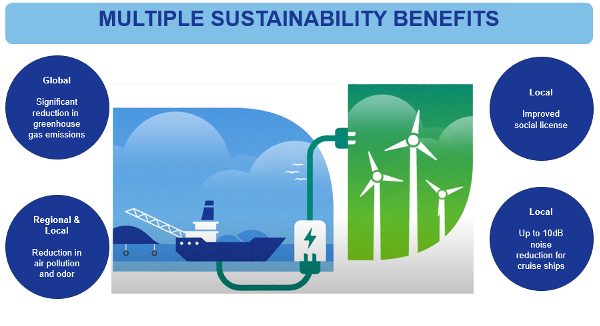
Multiple sustainability benefits anticipated by the introduction of shore power at Sydney’s White Bay Cruise Terminal (Source: Port Authority of New South Wales)
2. Future fuels call for a multi-fuel approach
While shore power can reduce emissions from vessels at berth, maritime decarbonization will also require cleaner fuels for vessel operations. There is unlikely to be a single fuel pathway. Each option differs in technology maturity, availability, cost, infrastructure needs, and safety requirements.
Ports will need to prepare for a mix of options. Biodiesel and renewable diesel may be more deployable in the near-term because they can use some existing systems. Bio-liquefied natural gas and methanol are emerging as medium-term options as vessels, supply chains, and bunkering infrastructure develop. Hydrogen, ammonia, and e-fuels may play a longer-term role, but will require more investment in storage, handling, safety systems, and market development.
This means ports need to plan for flexibility. Rather than betting on one pathway too early, they can assess likely demand, understand infrastructure requirements, engage with shipping and fuel providers, and identify investments that keep future options open.
3. Energy infrastructure and logistics can enable wider deployment
Beyond fuels and vessels, ports must also transform their energy systems and logistics capabilities. The Port of Newcastle illustrates this shift. As renewable energy projects expand across New South Wales, the port has become a key entry point for wind turbines and battery storage systems.
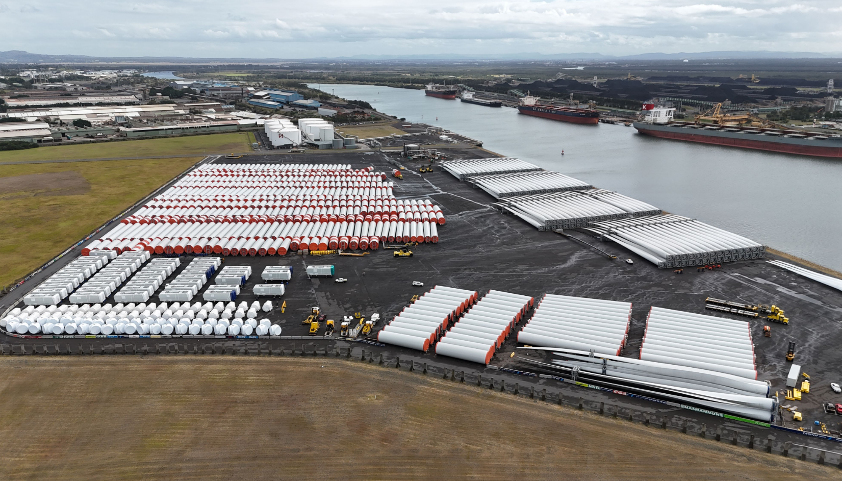
Windfarm blades stored at Port of Newcastle during transit. (Source: Port of Newcastle)
Wayne Mabbott described the scale of this logistics task, including wind turbine blades that have grown from about 65 meters a decade ago to 85 meters today, limited storage and laydown capacity, and the need to move oversized cargo through constrained road corridors.
These challenges are being addressed through coordinated planning, dedicated logistics precincts, additional hardstand areas, transport route updates, and stronger collaboration among ports, government agencies, project developers, and logistics providers.
What Successful Transition Can Deliver
Ports that invest early in energy transition readiness can unlock benefits beyond environmental outcomes. These include:
- Emissions reduction: Significant cuts in carbon dioxide, nitrogen oxides, sulfur oxides, and particulate matter.
- Operational efficiency: More reliable and diversified energy supply.
- Cost savings: Long-term reductions through energy efficiency, renewable electricity, and decreased fuel dependence.
- Resilience: Diversified energy sources and improved energy security.
- Economic opportunity: New roles as hubs for clean energy industries and related supply chains.
For Southeast Asia, these lessons are particularly relevant as ports balance growth, competitiveness, and climate goals. Energy transition readiness can help ports plan investments more strategically and identify where financing, policy support, and technical assistance may be needed.
Collaboration will Define the Next Stage
No single organization can deliver the energy transition alone. Progress will depend on collaboration among port authorities, shipping lines, energy providers, governments, regulators, technology developers, investors, and financiers.
At the same time, standardization and knowledge sharing will be essential. Ongoing work on global shore power guidelines and technical standards can help reduce fragmentation and accelerate adoption across ports of all sizes.
Looking ahead, key questions remain: How quickly can infrastructure scale to meet demand? Which fuels will become commercially viable first? How can smaller ports participate in the transition?
Ports that act early will be better positioned to navigate these uncertainties. By planning now, they can reduce emissions, strengthen resilience, and help shape a more sustainable maritime sector.
Learn more about ADB Green Ports Initiative: https://tinyurl.com/GreenPortsDataRoom