
Train on the Ha Noi, Viet Nam metro rail system. Photo credit: ADB.
Limited central government resources are pushing local governments to explore alternative sources of capital. At the same time, rising demands for infrastructure, public services, and climate action are placing unprecedented pressure on municipal budgets. Capital markets have emerged as an important funding source, helping cities mobilize long-term financing to meet infrastructure and service delivery needs.
Cities are the primary engines of economic growth, employment, and service delivery. They are also on the front lines of climate-related risk, including flooding, extreme heat, and water stress. These risks threaten lives and livelihoods, as well as the reliability of urban services, fiscal stability, and long-term economic competitiveness. As climate disasters intensify and become more frequent, cities must accelerate investments in climate-resilient infrastructure, adaptation measures, and nature-based solutions to protect communities and reduce future losses.
These investments, however, are capital-intensive and long-term and require financing solutions beyond what constrained municipal budgets can typically provide. GSS+ bonds offer one pathway for local governments to mobilize capital for these needs.
Rising Role of GSS+ Bonds in Municipal Finance
In recent years, a growing number of local governments have tapped capital markets by issuing green, social, sustainability, and other labeled (GSS+) bonds (Figure 1). Subnational issuers in countries such as Australia, Canada, Germany, India, Japan, the Netherlands, Norway, South Africa, Sweden, and Türkiye have used these instruments to deliver high-impact infrastructure projects and essential social services at the local level.
Figure 1: Annual Issuance of Local Government Bonds Globally
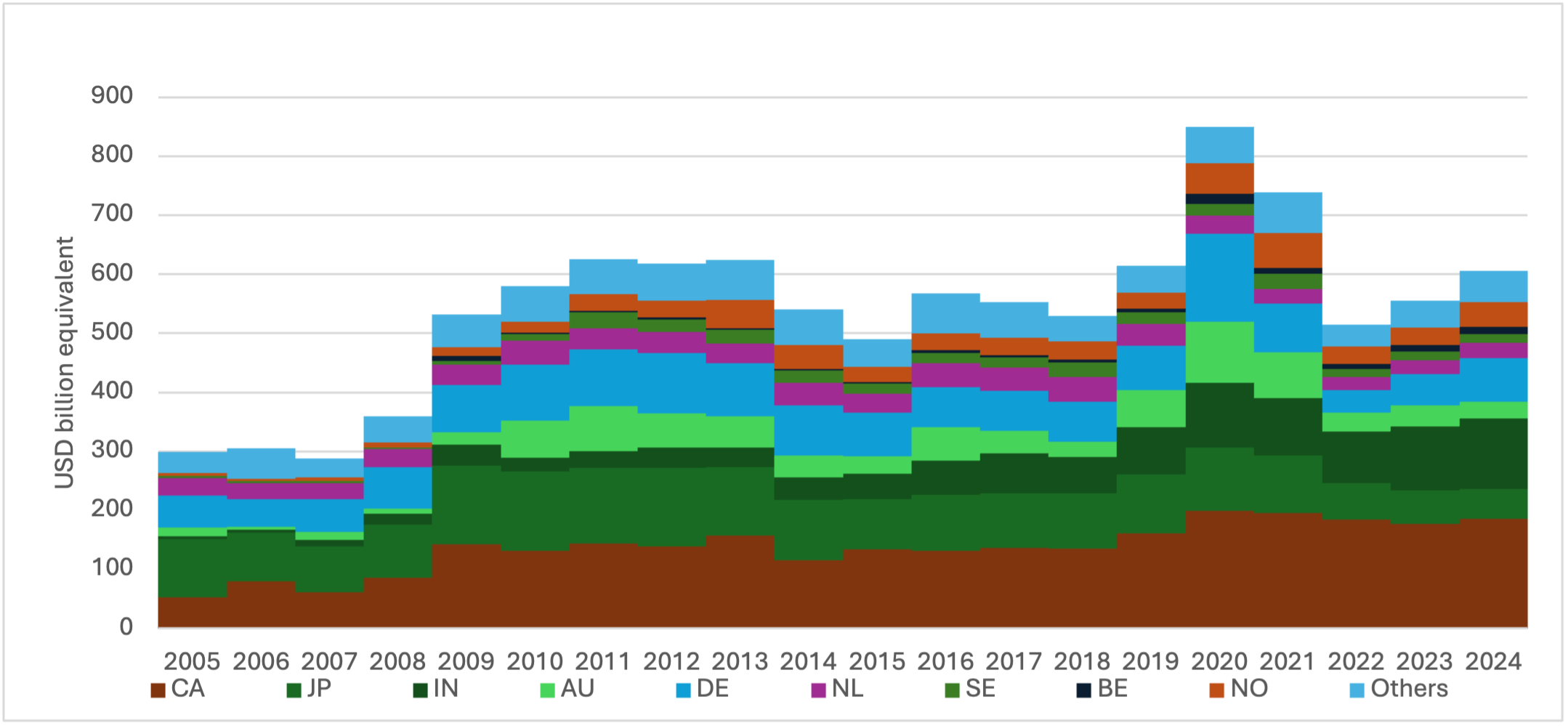 AU = Australia, BE = Belgium, CA = Canada, DE = Germany, IN = India, JP = Japan, NL = Netherlands, NO = Norway, SE = Sweden.
Notes: Data are as of 31 March 2025. Issuance amounts are based on United States dollar equivalent values at the time of issuance. Municipal bond market issuance tends to increase during times of crisis, such as the global financial crisis and the COVID-19 pandemic.
Source: Authors’ calculations based on Bloomberg LP data.
Beyond their role as a funding source, GSS+ bonds are a strategic tool for local governments to develop climate-resilient infrastructure, improve their ability to manage climate-related risks, and deliver measurable environmental and social outcomes. Eligible project categories commonly include:
- Mitigation: clean and low-carbon public transport, renewable energy, green buildings, energy efficiency, sustainable water and sewer infrastructure, and urban green spaces;
- Adaptation and resilience: flood and stormwater management, drought resilience, heat‑resilient infrastructure, climate-smart public buildings, and nature‑based solutions; and
- Social development: affordable housing, healthcare and education facilities, SME financing, employment creation, and access to essential services.
GSS+ bonds can also help deepen citizen involvement by giving local investors opportunities to support projects that directly affect daily life. When backed by clear disclosure and reporting, these instruments can enhance transparency, accountability, and trust in local investment decisions.
City-Level Experiences with GSS+ Bonds
Many cities have developed GSS+ bond issuance programs to support local sustainable development. The Tokyo Metropolitan Government (TMG), for instance, issued a COVID-19 response bond to rapidly provide emergency support to affected businesses. The city now regularly issues green and blue bonds to finance water management, renewable energy, and climate change adaptation projects at the local level. In October 2025, the TMG issued the world’s first resilience bond totaling a EUR 300 million to fund resilient infrastructure and countermeasures against storm and flood damage, aimed at safeguarding residents against growing climate and physical risks.
The City of Gothenburg in Sweden issued the world’s first municipal green bond in 2013. It has since expanded its green bond portfolio to finance projects to improve energy efficiency in municipal buildings, increase local renewable energy production, and reduce transport-related GHG emissions through modal shift infrastructure and electrified transportation.
GSS+ bonds have also been issued by local governments in developing economies. In South Africa, the City of Cape Town experienced severe drought conditions between 2015 and 2017 and responded by issuing a green bond to finance water-related adaptation infrastructure and water management projects to address the crisis and increase the city’s resilience to physical and disaster risks.
These examples illustrate how GSS+ bonds can help local governments mobilize private capital through local capital markets, align financing with local priorities, and deliver tangible climate and social benefits for their citizens.
Role of Central Governments and Enabling Frameworks
While local governments play a central role in identifying and delivering municipal infrastructure and services, central governments are critical enablers of effective local government bond markets. Sound policy frameworks, clear regulatory oversight, strong fiscal discipline, and institutional capacity building are essential to creating an environment where local governments can access capital markets responsibly and efficiently.
Successful issuance requires diligent planning and preparation at the local level. This includes identifying current and future infrastructure and service delivery needs, assessing socioeconomic trends, evaluating potential revenue streams, and considering climate-related physical risks. A national sustainable financing framework can promote policy coherence between local and central governments, particularly in identifying high-priority, high-impact eligible projects and establishing credible impact monitoring and reporting mechanisms.
Building institutional capacity, particularly in auditing, accounting, disclosure, and asset–liability risk management, is also necessary to prepare local government borrowers for long-term fiscal sustainability. Pooled financing vehicles can further help smaller local governments aggregate financing needs, reduce borrowing costs, and build market credibility, provided strong governance and clear institutional arrangements are in place. Multilateral development banks can also play a catalytic role through technical assistance, project pipeline preparation, guarantees, and other forms of support that help local governments access capital markets.
Together, these elements form the foundation for mobilizing capital markets to support resilient, inclusive, and climate-aligned local development.
This blog draws on ADB's technical study, Mobilizing Capital for Local Government Finance in Asia and the Pacific Through Green, Social, and Sustainability Bond Markets. The publication was developed through ADB’s regional technical assistance under the Asian Bond Markets Initiative, with support from the People's Republic of China (PRC) Poverty Reduction and Regional Cooperation Fund and the ASEAN Catalytic Green Finance Facility, through contributions from the Green Climate Fund and the United Kingdom.