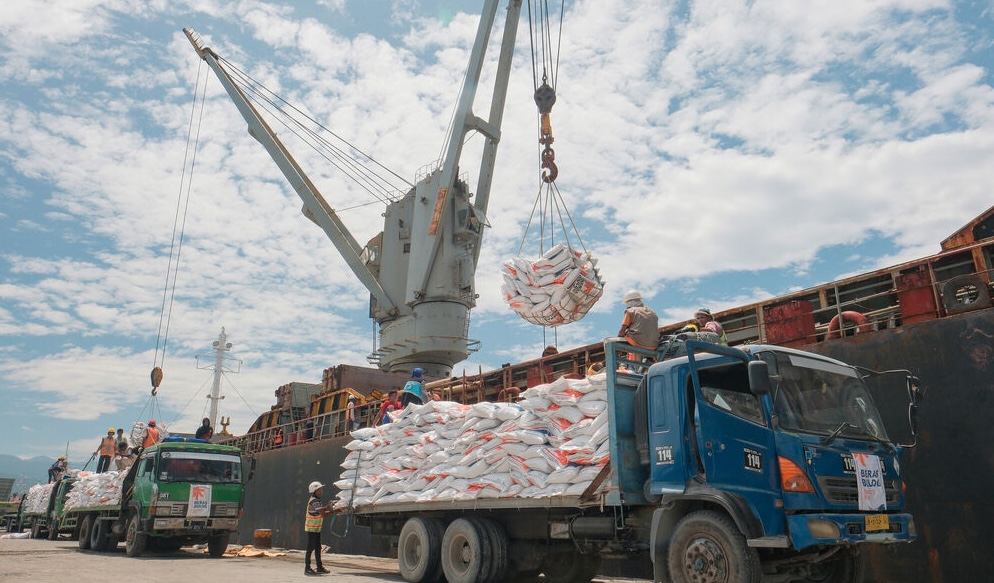
Leading dry bulk operators are moving from reactive compliance to integrated, data-driven environmental management, offering lessons for Southeast Asia's expanding port sector.
Dry bulk cargo ports are the quiet workhorses of the global economy. They move the coal, grain, fertilizer, cement, sulfur, and minerals that underpin energy systems, food security, and industrial production. But the very nature of bulk handling, open stockpiles, conveyor systems, ship loading, and high-volume truck and rail movements can generate environmental pressures that are difficult to mask: fugitive dust, contaminated stormwater, and equipment-related emissions.
For Southeast Asia, where many bulk ports sit alongside dense urban centers, productive agricultural land, and sensitive coastal ecosystems, those pressures are sharpening. Tropical rainfall mobilizes stockpile residues, prolonged dry spells lift dust further, and tightening regulations, ESG-aware investors, and increasingly engaged communities are raising the bar on what good environmental performance looks like. Reactive compliance is no longer enough.
The sixth webinar in the Asian Development Bank's (ADB) Green and Resilient Ports series brought together four practitioners to share what an integrated, data-driven approach to managing dust, runoff, and emissions looks like in practice. Their experiences offer Southeast Asia's port authorities and policymakers a working playbook for building environmental resilience without sacrificing throughput.
Why Dry Bulk Demands a Different Standard
Most port environmental conversations focus on emissions, water, and energy. Dry bulk adds another layer: the cargo itself becomes the impact. Coal, fertilizer, sulfur, grain, clinker, and cement all generate dust, contaminate stormwater, and react to weather in ways that container or general cargo do not.
Nathan Juchau, Manager Sustainability at the Newcastle Coal Infrastructure Group (NCIG), described the situation directly. NCIG operates a single-site coal export terminal with approved capacity of 79 million tonnes per annum, moving high volumes at high rates near industrial, commercial, and residential neighbors, and within reach of internationally significant wetlands. That proximity, he explained, adds both complexity to how the site is managed and a clear layer of obligation on what is required to manage it well.
Mohd Rafizal bin Esmail, General Manager of the Bulk and Break Bulk Terminal at Johor Port in Malaysia, made the same point from a multi-cargo perspective. Johor Port handles around 1.4 million tonnes of clinker, 1.3 million tonnes of cereals, and over 1 million tonnes of fertilizer and minerals each year. Each commodity behaves differently, each is sensitive to weather, and all of them pass through open handling activities, multiple transfer points, and conventional equipment.
The common factor is exposure. The conditions that mobilize dust, flood stockpiles, or accentuate community impacts are no longer outliers. As Nathan noted, the increasing frequency of extreme weather events is making it more important than ever to get these controls right. Climate variability has shifted environmental management from a static compliance function into an active operational risk.
Engineering Out the Risk: From Plant Design to Passive Dust Control
The first line of defense is design. NCIG's environmental management system is built on an integrated set of controls, including plant design, operational practices, inline moisture monitoring, and an automated dust suppression system that responds in real time to weather data and forecast conditions. The system can apply more water, slow throughput, pre-wet stockpiles, or apply manual veneering ahead of incoming weather systems. Compliance and operational monitoring run continuously, allowing controls to be adjusted on the fly.
Equipment innovation is reshaping what is possible at the cargo interface itself. Jason Whaanga, General Manager of DSH Systems, described how passive dust control loading systems, now installed at over 10,000 sites across 74 countries, can reduce dust emissions by up to 96% on suitable products. The design principle is to control the material from entry to discharge: backfilling the hopper to remove air from the cargo so it discharges as a solid, heavy column that fills the receiving pile from within rather than aerating into the atmosphere.
The benefits flow well beyond air quality. A site in China that installed DSH hoppers on a soybean operation reported a 60% reduction in cleaning and a 40% reduction in maintenance. An overseas port that had been threatened with closure due to fertilizer dust complaints from across the harbor resolved the issue with passive technology alone. The lesson, as Jason summarized, is that the cheapest dust to manage is the dust you never let escape.
For specific commodities, full enclosure changes the equation entirely. Rebecca James, Manager Environment at Fremantle Ports in Western Australia, described the operation of Australia's first Siwertell enclosed unloader, installed in 2001 at Kwinana Bulk Jetty to unload sulfur at 1,200 tonnes per hour. The system uses a fully enclosed counter-rotating screw mechanism, eliminating dust escape, removing the need for water sprays and dust monitoring networks, and preventing spillage into the harbor or onto the berth. It also uses 30 to 50% less energy per tonne handled than traditional grab unloaders. Rebecca was clear that the technology is not universal, capital costs are high, and Siwertells are best suited to dedicated, single-commodity operations rather than multi-cargo terminals .But where it fits, the environmental performance is transformative.
“If you want to control the dust, control the material for as long as you can.”
- Jason Whaanga, General Manager, DSH Systems
Operational Discipline: The Quiet Multiplier
Even the best equipment underperforms without disciplined operations. Mohd Rafizal's experience at Johor Port reinforced this throughout his presentation. With diverse, weather-sensitive cargoes and largely conventional handling equipment, Johor's environmental controls rely as heavily on operational practice as on infrastructure.
Three measures stood out:
- Source control on cargo drops. Crane operators are coached and supervised to position grabs as close to the receiving hopper as possible before opening, reducing the height, and the dust plume, at every transfer.
- Designated tipping zones and tarpaulin cover. Truck drivers tip into specific bunded areas and loading bins are tarpaulined to protect cargo during rainfall and prevent residue washing into the harbour.
- Idle reduction and just-in-time deployment. Johor has introduced an unmanned weighbridge system that has reduced truck waiting time from five minutes to thirty seconds, alongside designated idle zones, engine-off practices, optimized truck routing, and just-in-time excavator deployment. Less idling means less fuel burned, and lower emissions, with no capital outlay.
NCIG complements these approaches at scale. Over 90% of NCIG's water is now recycled or captured on site, a significant shift driven by Australian drought conditions and a deliberate decision not to compete with community water security during dry periods. Routine groundwater monitoring, spontaneous combustion controls, stormwater infrastructure, and active habitat management for two endangered species all sit alongside the dust system as part of a single, integrated environmental program.
Key insight: At Johor Port, switching to an unmanned weighbridge cut truck waiting time from five minutes to thirty seconds. Operational efficiency may be the most underestimated environmental control available to bulk ports; emissions reductions do not always require capital expenditure.
The lesson for Southeast Asia is direct. Environmental performance is not a fixed function of the equipment a port owns. Operational discipline, supervision, training, and continuous improvement can deliver meaningful gains in parallel with, or ahead of, capital investment, particularly for ports working with mixed cargoes and conventional infrastructure.
Transparency, Trust, and the Social Licence to Operate
Across all four presentations, the same point surfaced repeatedly: technical controls only earn their value when stakeholders understand and trust them.
Nathan described how NCIG's sustainability strategy is built around transparency, clearly articulated commitments, public targets, performance reporting, management approach documents, policy disclosures, and accessible background data. As he put it, it is good to do good work, but it is better to do good work and have people know about it. That transparency is what allows NCIG to be challenged on its commitments, demonstrate ownership of areas where performance falls short, and continue to strengthen its standing with regulators, customers, and the surrounding community.
Rebecca described a similar dynamic at Fremantle Ports, where environmental licences sit with the port even though stevedoring is contracted out. Fremantle has developed its own internal berth-handling and environmental standards, contractually binds stevedores to them, and maintains dedicated staff to inspect performance during loading and unloading rather than waiting for a breach to be reported. The relationship between port and operator becomes one of shared accountability rather than reactive enforcement.
Mohd Rafizal made the same point from a different angle: environmental performance is not something a port can deliver alone. Cargo owners, contractors, transporters, and stevedores all need to be brought into the operating model, through specifications, training, supervision, and shared expectations. The role of the port authority is to set the standard and hold all parties to it, consistently and visibly.
For ports across Southeast Asia, this matters well beyond reputation. Regulators are tightening expectations, financiers are scrutinizing ESG performance, commodity buyers are requiring evidence of responsible operations, and communities increasingly have the social and political channels to hold port authorities to account. Ports that can demonstrate measurable, transparent, integrated environmental management will find it easier to retain approvals, attract capital, and grow throughput. Those that cannot may find both increasingly restricted.
What This Means for Southeast Asia
Dry bulk cargo will remain central to Southeast Asia's economic growth, and to the trajectory of its energy transition, food security, and industrial development. The ports that handle it can either treat environmental management as a cost of compliance or as a foundation for resilience, competitiveness, and access to capital. The webinar's four panelists made the case, in different ways, for the second path: design out what you can, operate with discipline around what remains, and be transparent about both.
None of this requires perfection. It requires intent. The pathway is well established: integrated environmental management systems, monitoring infrastructure, equipment investment where it is justified, operational discipline where it is not, and a transparent relationship with regulators, financiers, communities, and supply chain partners. For policymakers and port authorities across the region, the opportunity is to apply these lessons now, while infrastructure investment cycles are still open and stakeholder expectations are still being shaped.
Building environmentally resilient dry bulk ports is not a single project, it is a continuing operating discipline that pairs the right technology with the right behaviors, supported by transparent data and trusted relationships. The ports that get this right will be the ones that continue to grow, attract capital, and earn the long-term trust of the communities and ecosystems around them.